
We get asked one question more than any other: "Sure, K-Dense Web is fast, but what is it actually worth?"
So we did the math. Use case by use case, line item by line item.
For every public K-Dense Web example, we estimated what it would cost and how long it would take a qualified human professional, working full-time without context switching, to produce the same final artifact (paper, decision memo, due diligence report, slide deck) and the same intermediate work (data acquisition, ML pipelines, figures, references) alone. We then compared that human-alone baseline to the actual K-Dense Web + human wall-clock and credit cost.
Here is what fell out.
The headline numbers
Across 67 public use cases:
| Metric | Human alone (consultant rates) | K-Dense Web + human (Plus plan) |
|---|---|---|
| Aggregate cost | $3,087,800 | $5,670 |
| Aggregate hours | 14,568 (364 person-weeks) | 167 |
| Median per-case cost ratio | 560× | |
| Median per-case time compression | 107× |
That is $3.08 million of professional analyst work delivered by K-Dense Web + human for less than $6,000 in credits. The same body of deliverables would absorb roughly seven full-time analysts for an entire year if done by humans alone. K-Dense Web + human produced it in about four standard work weeks of cumulative wall-clock time across the 67 sessions.
The aggregate cost ratio is 545×. The median use case is 560× cheaper than its human-alone equivalent and 107× faster.
The shape of those savings is easier to see in a chart than a table. The top 12 deliverables alone account for just under $1 million of human-alone analyst work:
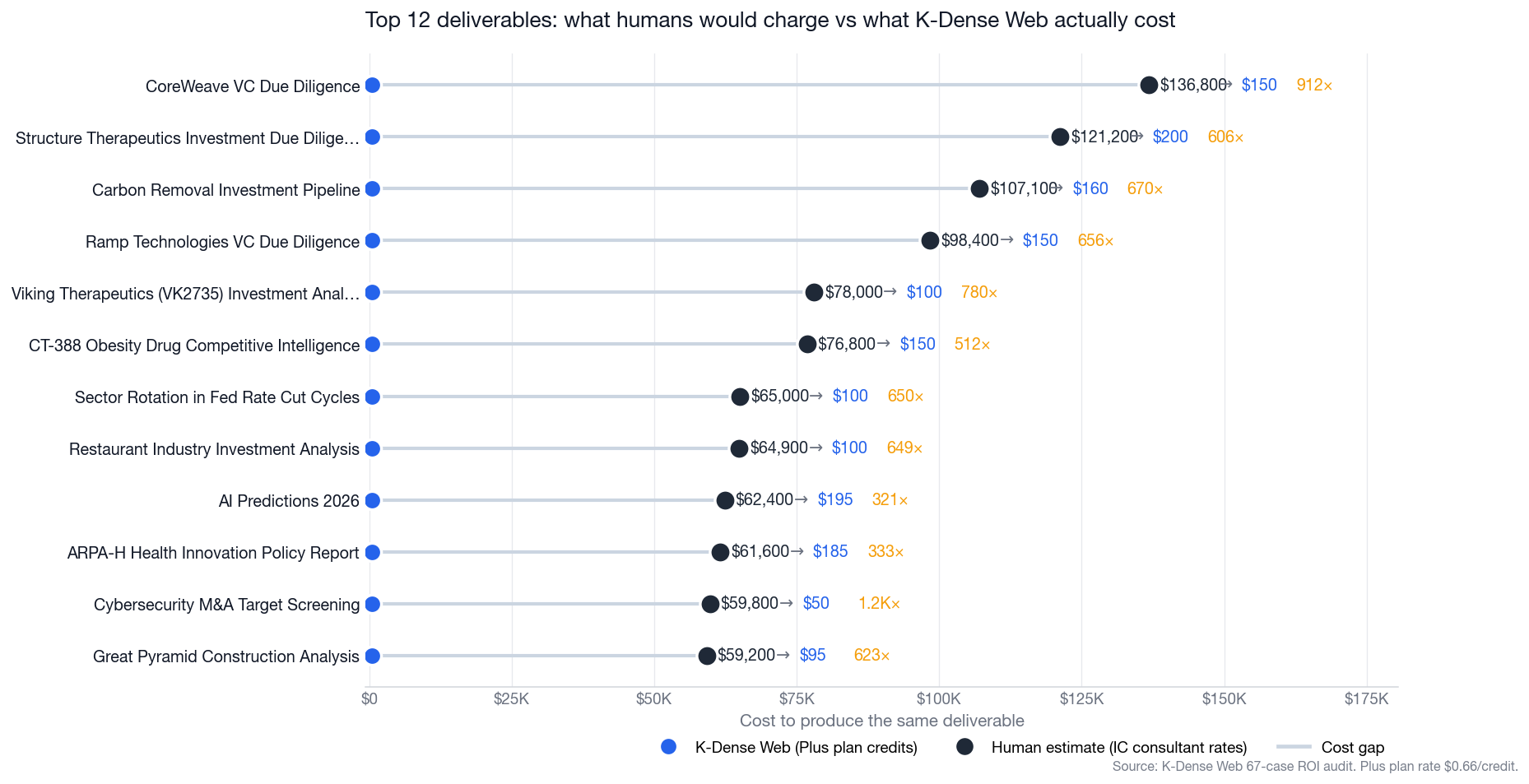
Figure 1. The top 12 use cases by absolute dollar savings. Each row connects the K-Dense Web + human cost (blue) to the equivalent human-alone estimate (slate). Multipliers are shown in amber.
A few representative cases
The biggest absolute savings come from the kinds of deliverables that organizations already pay outside firms to produce.
| Deliverable | Pages / figures | Human-alone estimate | K-Dense Web + human | Cost saved | Time saved |
|---|---|---|---|---|---|
| CoreWeave VC Due Diligence | 63 pages, 12 figures | $136,800 | $150 | $136,650 | 11.4 weeks → 5 hr |
| Structure Therapeutics Investment DD | 52 pages, 16 figures | $121,200 | $200 | $121,000 | 10.1 weeks → 6 hr |
| Carbon Removal Investment Pipeline | DAC/OAE memo | $107,100 | $160 | $106,950 | 11.9 weeks → 2 hr |
| Ramp Technologies VC Due Diligence | 44 pages | $98,400 | $150 | $98,250 | 8.2 weeks → 4.5 hr |
| Viking Therapeutics catalyst report | Equity research | $78,000 | $100 | $77,900 | 6.5 weeks → 2.3 hr |
| CT-388 Competitive Intelligence | 44 pages | $76,800 | $150 | $76,650 | 6.4 weeks → 5 hr |
| Sector Rotation Macro Strategy | 31 pages, 15 figures | $65,000 | $100 | $64,900 | 6.5 weeks → 5 hr |
| ARPA-H Policy Report | 42 pages, Brookings-grade | $61,600 | $185 | $61,415 | 7.7 weeks → 4 hr |
| Cybersecurity M&A Target Screening | 14 pages, 9 figures | $59,800 | $50 | $59,750 | 4.6 weeks → 75 min |
The Cybersecurity M&A screening is worth pausing on. It is a 14-page memo with nine figures: target screen, EV/revenue precedents, accretion/dilution, acquirer scoring. A human analyst billing $325/hr would book 184 hours, or 4.6 full-time weeks, to produce the same output alone. K-Dense Web + human returned it in 75 minutes for $50 in credits. That is a 1,196× cost ratio on a single deliverable.
The pattern repeats. The Caribbean CBI tax strategy is a $41,000 piece of senior tax/legal research as a human-alone effort, compared with $36 in credits for K-Dense Web + human (1,139×). The HER2 ADC competitive intelligence brief is a $58,800 human-alone biotech CI report, compared with $50 for K-Dense Web + human (1,176×). The CoreWeave DD package, scored in the audit as a $136,800 human-alone effort, ran for $150 with K-Dense Web + human.
These are not isolated edge cases. The full distribution of cost ratios across all 67 use cases tells the story:
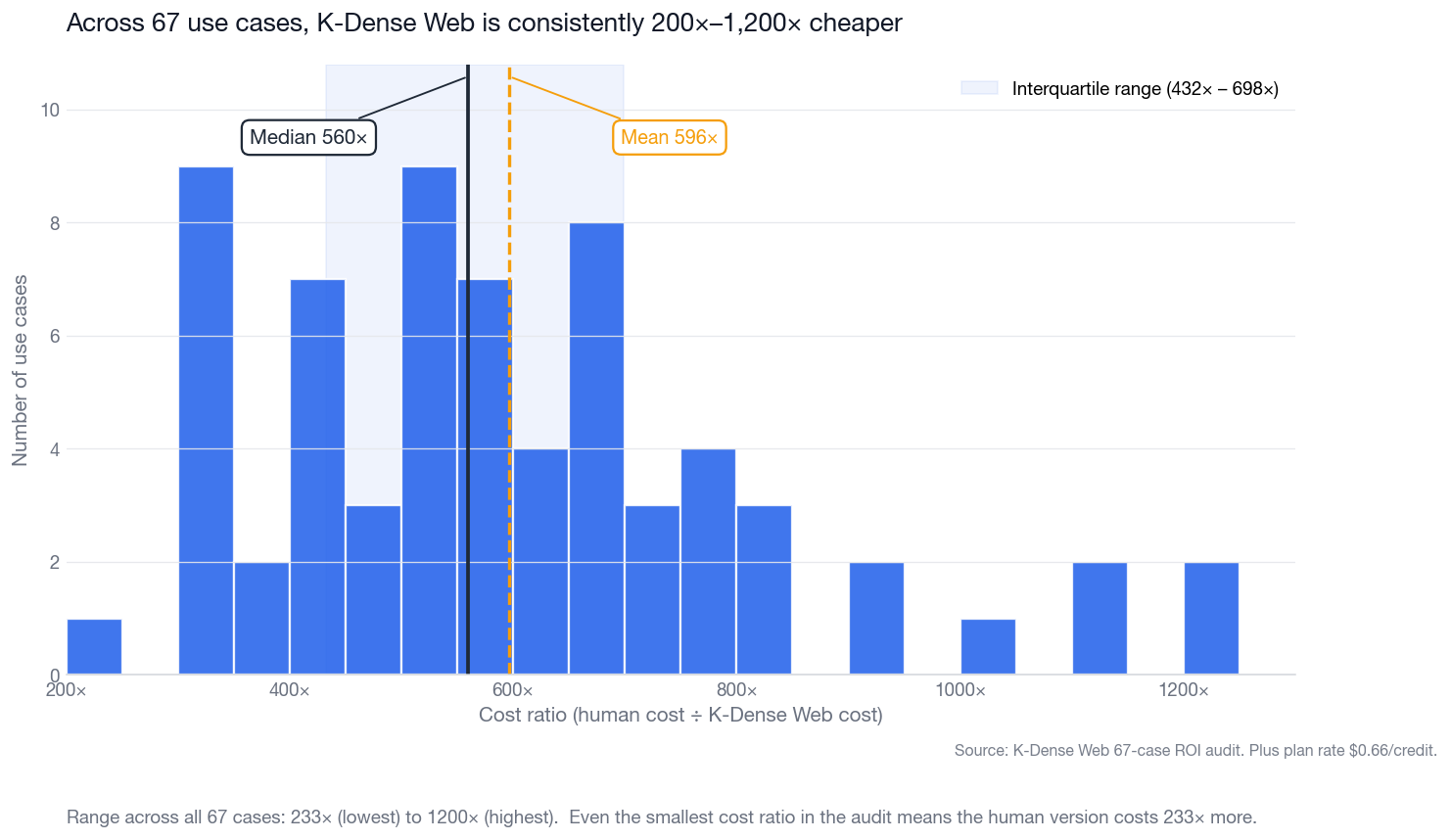
Figure 2. Distribution of cost ratios across all 67 use cases. The lowest ratio in the audit is 233×; the highest is 1,196×. Half of the audit lands in the interquartile range of 432× to 698×.
How we counted human-alone cost
For every use case we summed the hours a qualified specialist would spend if completing the deliverable alone:
- Scoping and literature review
- Data acquisition, cleaning, harmonization
- Analysis, modeling, ML pipelines, statistics
- Figure generation (1 to 3 hours per polished figure)
- Writing (1.5 to 3 hours per final page)
- Peer review and revision (10 to 20 percent of writing time)
We then multiplied by mid-market US 2025 IC consulting rates: $175/hr for computational biology and bioinformatics, $200/hr for ML and engineering analysis, $250/hr for macro strategy, $275/hr for equity research, $300/hr for VC due diligence (associate plus partner blend), $325/hr for M&A advisory, and so on.
Importantly, what we did not count:
- Data licensing fees. Bloomberg, Capital IQ, cBioPortal Pro, FAERS commercial licenses, premium news/IP databases.
- Software licenses. MATLAB, ChemDraw, COMSOL, Simcyp, NONMEM.
- Project management overhead and PI/principal review time.
- Calendar overhead. Our human-hour estimates assume one specialist working full-time without queueing, meetings, or vendor turnaround. Real calendar time is typically 2 to 5 times longer.
- Boutique fixed-fee deliverables. Wall Street IB-grade DD reports list at $50K to $500K each. Brookings, RAND, and GAO-grade policy reports are typically $80K to $300K. We used IC-rate × hours instead, which is the floor.
Each of these would widen the gap further. The numbers above are deliberately conservative.
K-Dense Web + human cost is calculated at the Plus plan effective rate of $0.66/credit ($199 for 300 credits). That is what a real Plus subscriber actually pays.
Where the leverage shows up
The audit covers 40+ categories. The biggest dollar savings concentrate in the categories where humans bill the most hours at the highest rates:
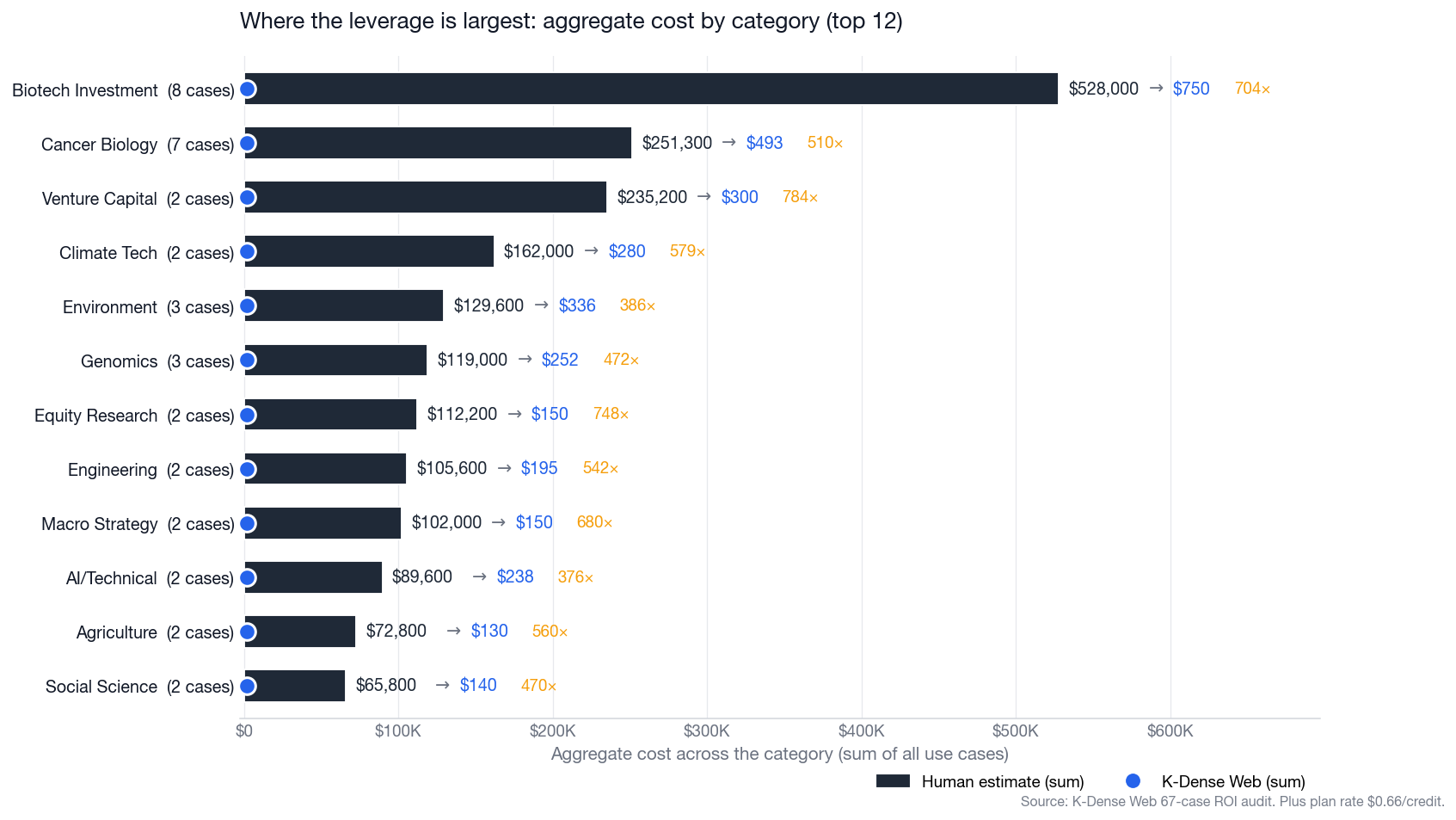
Figure 3. Aggregate human-alone cost vs K-Dense Web + human cost by category, summed across all use cases in each. Biotech Investment alone accounts for over half a million dollars of human-alone analyst work for $750 in credits.
| Category | # Cases | Human-alone cost | K-Dense Web + human cost | Cost ratio |
|---|---|---|---|---|
| Biotech Investment | 8 | $528,000 | $750 | 704× |
| Cancer Biology | 7 | $251,300 | $493 | 510× |
| Venture Capital | 2 | $235,200 | $300 | 784× |
| Climate Tech | 2 | $162,000 | $280 | 579× |
| Equity Research | 2 | $112,200 | $150 | 748× |
| Engineering | 2 | $105,600 | $195 | 542× |
| Macro Strategy | 2 | $102,000 | $150 | 680× |
| M&A Analysis | 1 | $59,800 | $50 | 1,196× |
The same pattern holds on the time axis. Plotting human-alone full-time hours against K-Dense Web + human wall-clock for every use case, the median case lands at 107× compression and the fastest cases approach the 500× guide:
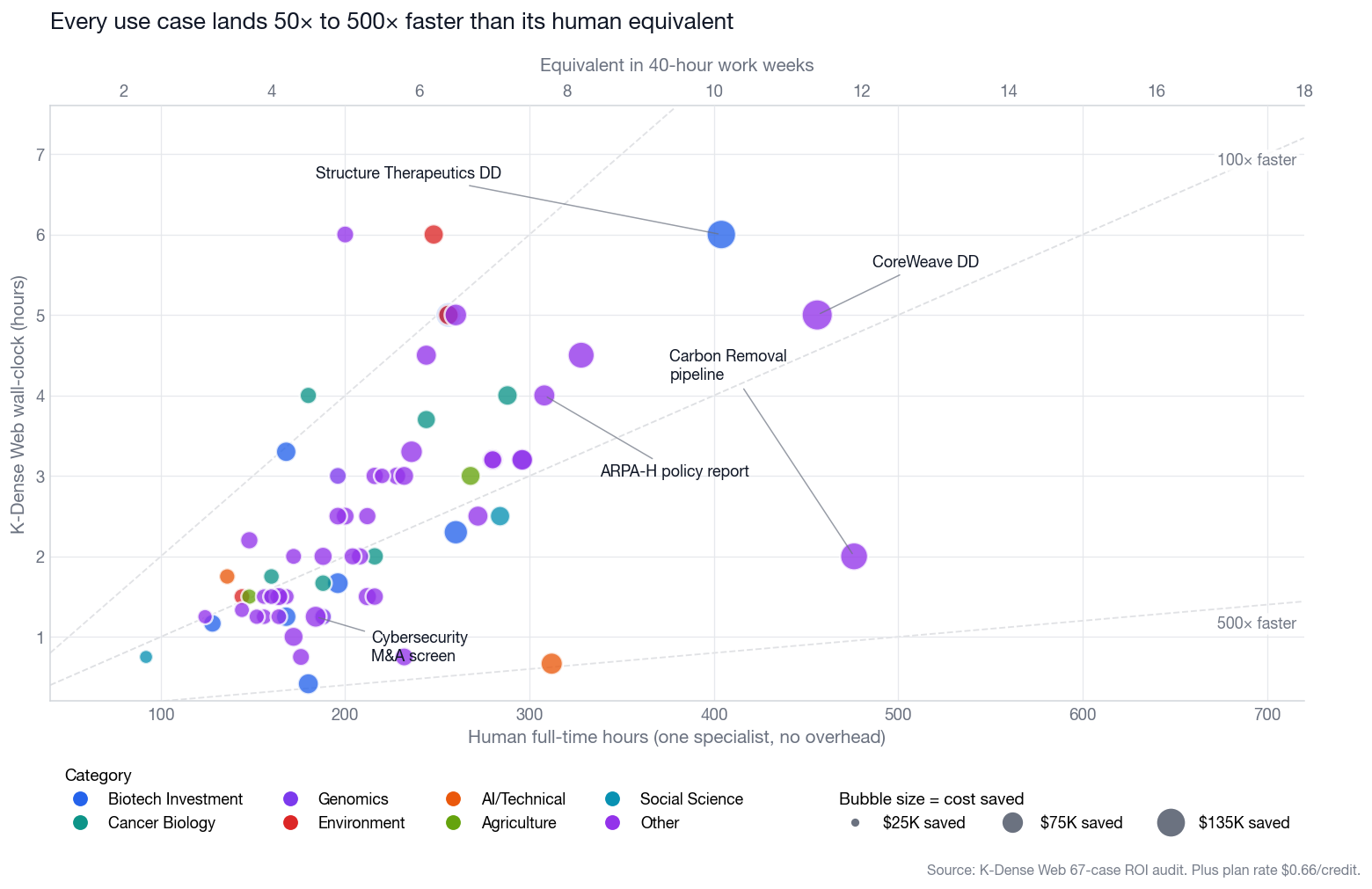
Figure 4. Time compression across all 67 use cases. Bubble size scales with absolute dollar savings; color encodes category. The largest, top-right bubbles are the multi-week DD reports (CoreWeave, Structure Therapeutics, Ramp). Most cases clear the 50× guide, while a few longer-running travel, environment, and oncology analyses fall below it.
The pattern holds across every category we audited, including ones that get less attention: $40,500 saved on a natural-products drug discovery manuscript (antimicrobial NP screening), $42,250 on a quantum chemistry VQE benchmarking paper, $39,800 on an ICD adverse events technical report, $54,250 on an India EV adoption econometrics paper, $32,850 on a longevity gene translation scorecard. Wherever specialist hours are required, K-Dense Web + human delivers the work at roughly two orders of magnitude less than human-alone execution.
What this means for budgets and decisions
The takeaway for budget owners and decision makers is more specific than "AI is cheaper than people." The relevant comparison is K-Dense Web + human versus human alone.
For research and analytics functions. A single Plus seat is $199/month and includes the credits for several medium-tier deliverables. In this audit, each additional report ran $36 to $200 in credits, with most clustered from $50 to $200. Most teams do not have a productivity problem on the analyses they already run. They have a problem with the analyses they never get around to. K-Dense Web + human closes that gap at the marginal cost of a few credits.
For finance and investment teams. Every deal you would otherwise screen out for lack of analyst time is now in scope. The CoreWeave-style 63-page DD package, fully figured and modeled, was historically a six-figure human-alone decision before you even opened the file: do we spend $100K+ to look hard at this opportunity? K-Dense Web + human turns that into a $150 question. See the VC due diligence walkthrough for what that actually looks like.
For pharma and biotech. Translational decisions that traditionally absorbed weeks of specialist-only time (target validation, competitive intelligence, mechanism papers, FAERS safety signals, biomarker landscapes) now run in hours with K-Dense Web + human. The work that used to gate a go/no-go meeting now sits inside the meeting. The GBM clinical trial landscape analysis and DLBCL biomarker discovery posts are concrete examples.
For policy, strategy, and engineering. A 42-page Brookings-grade ARPA-H policy report came in at $185 in credits. A 50m concrete dome structural analysis came in at $100. Both are below the discretionary spend threshold of any director-level manager. The procurement question, at this price point, simply goes away.
The conservative case
We have framed all of this against human-alone IC consulting rates, not market prices for the same work.
The actual market price for the deliverables in this audit is meaningfully higher than $3 million. Wall Street boutique investment DD reports list at $50K to $500K each. Think-tank policy reports are $80K to $300K. Real consulting teams blend senior partners (often 2 to 4 times the rates we used) with junior support, plus PM and review overhead. Specialty firms charge fixed fees that bear no relationship to hourly billing.
We did not need any of those upward adjustments to make the case.
At the floor, K-Dense Web + human is delivering $3,087,800 of work for $5,670. At realistic market rates the number is several multiples higher. At calendar-time-adjusted rates (factoring in the 2 to 5 times overhead on real human-alone delivery) the time compression is much larger than the 107× median we report.
What to do with this
The simplest test is to run K-Dense Web + human on a deliverable you already know the cost of: a DD report your team turned around last quarter, a competitive landscape your VP commissioned externally, a translational dossier your CRO charged you for. Compare hours, dollars, and what came back.
If the audit numbers hold for your work, the implication is direct. Your existing analytical bandwidth becomes a multiplier, not a constraint. The reports you previously commissioned externally become same-week internal deliverables. The deals, programs, and questions you previously ranked as "below the threshold to look at carefully" move back into scope.
That is the version of the take-home worth bringing to your CFO: K-Dense Web + human is not just a productivity tool, it is a cost-of-decision tool. It changes which questions are worth asking.
Run an analysis on your next deliverable →
The full per-case audit covers 67 use cases with line-item assumptions, hour counts, rates, credit estimates, and links to every original session and PDF. Estimates are order-of-magnitude (±30%) by design. Methodology details and category subtotals are summarized at k-dense.ai/use-cases. For enterprise engagements that quantify expected impact against your specific portfolio, visit k-dense.ai/enterprise.